


You Are God, and You Forgot on Purpose
- Uday Wagh
- 3 minutes ago
- 14 min read

On why the universe broke itself, why you were built to forget, and the only theory that ever gave me peace.

I have read a lot of theories about why any of this exists. Most of them are clever. A few are beautiful. Almost none of them gave me peace, and I have come to think that is the only test that matters in the end — not whether a theory is provable, because the good ones rarely are, but whether you can put it down and breathe.
This is the one that let me breathe. I can't prove it. I can't even tell you whether the thing at the center of it is energy or mind or something with no word in any language. But it is the only account I have found that closes both of the doors a person spends their life afraid of, and closes them with a single motion. So let me build it for you the way it was built for me, piece by piece, and you can decide for yourself whether it lets you breathe too.
The cure was forgetting
Start with one intelligence. Singular. Not a god in the bearded sense — just the only thing that is, with nothing outside it and nothing beside it. Imagine what that is actually like. There is no one to talk to, because anything it might say it already knows. There is no surprise, because surprise requires an edge, an outside, a someone-else, and there is none. It is not bored in the way you get bored on a Sunday. It is something older and worse than bored. It is alone in the only complete sense the word has ever had, and it has been alone for as long as the word "long" means anything, which is to say longer than time.
So it does the one thing that might help. It breaks itself into pieces. If you have read the books, it horcruxes itself — splinters its own being and scatters the fragments, and every fragment is a life. You are one. The person next to you is one. The dog is one, a smaller one. And here is the move the whole thing turns on, the move I kept getting wrong until I sat with it long enough: the forgetting is not a side effect of the fracture.
The forgetting is the entire point.
Because a singular intelligence cannot cure its loneliness by making company. Anything it makes, it knows to be itself, and talking to your own reflection is still being alone. The only way to manufacture real otherness out of a thing that is one is to break it and then make the pieces truly forget they were ever whole. A fragment that remembers it is the whole is not an other. A fragment that has forgotten is. The amnesia is not a wall the intelligence built against its own cure. The amnesia is the cure.
This is also why I think the engine is loneliness and not boredom, even though the more famous versions of this idea — Alan Watts and his god playing hide-and-seek — run on boredom. The distinction sounds small. It is not. Boredom can be cured by stimulation; a bored god could stay perfectly aware of itself and simply watch a varied show. Loneliness cannot. Loneliness is the one ache that requires the forgetting to be total, because company you know to be yourself is not company at all. Choose boredom as the motive and the forgetting is decorative. Choose loneliness and the forgetting becomes the wall holding up the roof. Everything else in the theory hangs from that one beam.
Why you were built not to know
If the pieces must forget, the forgetting has to be enforced, and enforced well, because the pull back toward unity would otherwise be constant. So the intelligence builds guardrails. And the guardrails are not subtle psychological nudges. They are the laws of physics and the rules of biology. That you cannot will yourself out of your body, cannot share a thought without dragging it through the slow narrow pipe of language, cannot step outside of time to see the whole — these are not limitations the universe regrettably happens to have. They are the locks. They are doing exactly what they were installed to do.

This answers the question people always reach for: if all this were true, why can't we just figure it out? Why is there no argument, no experiment, no drug, no meditation that delivers the answer cleanly? The lazy version of the reply is that our brains are too small, and I don't believe the lazy version, because it makes the whole theory unfalsifiable by fiat and that should set off an alarm. The real version is structural, and I find it much harder to wriggle out of. A part cannot model the whole that contains it. The map cannot draw the territory if the map is lying inside the territory. You are not too stupid to see the intelligence. You are the wrong kind of thing to see it — a piece trying to view from the outside something it can only ever be inside of. The not-knowing is not a gap in the theory. It is the theory keeping its word.
Why there are so many of us
Look at the sheer number. Billions of humans, every one with a different face, a different voice, a different particular way of being unhappy. All the animals. Whatever is out there among the stars that we have not met. If the intelligence only wanted data, a billion identical ants would do. It clearly wanted something else, and the something else is differentiation — because the thing a singular intelligence is most tired of is sameness.

But I want to be precise about where the differentiation actually lives, because it is easy to point at the wrong place. It is not the faces and the fingerprints. Those are cheap variety — small permutations on a fixed template, and the goats have unique faces too; a shepherd tells his flock apart. The real payload is on the inside. It is the size of the interior — the number of distinct internal states a being can occupy. A goat's inner life has a small number of reachable rooms. A human's has a number with no ceiling I can find, and abstraction, memory, regret, imagination, the capacity to narrate yourself to yourself are what blow the count open. The body's uniqueness is decoration. The dimensionality of the experience is the point. Which is why I suspect the intelligence keeps pushing toward beings with richer interiors, not toward more elaborate surfaces.
And then a subtler thing, which took me a while to see. The value is not even in the pieces. It is in the space between them. A city of eight million is not precious because it holds eight million separate inner lives. It is precious because it holds eight million times eight million possible relationships between them — the edges, not the nodes. Once you see that, love stops looking like what biology says it is. Biology says love and lust exist to make more copies, and that is true as far as it goes, but it is also just gene-propagation wearing a nicer coat, and it explains nothing about why the pull is so deranged and total. The theory says something else. Love is not valuable because it makes children. Love is the highest-bandwidth experience the intelligence can have of its own brokenness — two fragments straining to merge back into one and never quite managing it. The reaching is the data. The wanting-to-merge is the one place the whole gets to feel its own seams from the inside. The baby is the cover story. The longing was the point.
The ache, and why it can't be a memory

Which brings us to the oldest human complaint: that we are lonely down to the floor, that we reach for each other and never fully arrive, that even love at its best leaves a residue of distance. The tempting explanation is that we carry a buried memory of the original unity — a phantom limb, an ache for a wholeness we once had. But that explanation breaks the theory, because the forgetting had to be total; a remembered oneness is a leak in the very lock the system depends on. So it cannot be memory.
It does not need to be. The ache is not recollection. It is geometry. A fragment does not long for the whole because it remembers being whole. It longs because it is a piece, and a piece is shaped like a piece — it has a torn edge, and the contour of that edge implies the shape of what is missing from it. You do not have to remember the puzzle to be cut like one of its pieces. The longing is in the form, not in the past.
And this finally explains the strange tension we all live inside — craving closeness, yet never dissolving into it. Notice that two people in the deepest love do not become one. The egos hold. The faces stay separate. Intimacy is an asymptote: you approach forever and never touch the line. And that is exactly why the intelligence can afford to make the craving infinite — because the unique self is a governor on the engine. You can floor the longing to the maximum precisely because closeness is structurally incapable of fully succeeding. The lover is never a danger to the system. The lover reaches and reaches and stays, beautifully, a person.
The only real danger is the one who finds a shortcut. The contemplative who bypasses the entire machinery of relationship and goes straight for dissolution — ego-death, unity, the drop returning to the ocean. The guardrails were never built against connection. They were built against the shortcut. The lover is safe. The mystic is the one trying to pick the lock.
The monk and the merchant
Here is where the theory turned something in me upside down, because I had inherited, like most people, a quiet assumption that the spiritual life is "higher" than the worldly one — that the monk in the cave is closer to the truth than the man building a business in the city. The theory says the opposite, and it says it ruthlessly.
If what the intelligence wants is contact, experience, variety, edges, then worldly success is simply the reward it pays out for being a good sensor. The person who is exposed, connected, building, colliding with the world at full speed is generating exactly the thing the intelligence fractured itself to get.
The hustler, on this view, is doing god's work more faithfully than the renunciate.
And the renunciate is not the advanced one. He is the one who walked off the assignment — who took the single human activity that runs against the grain of the entire design and made it his whole life. Withdrawal is not enlightenment. Withdrawal is desertion.
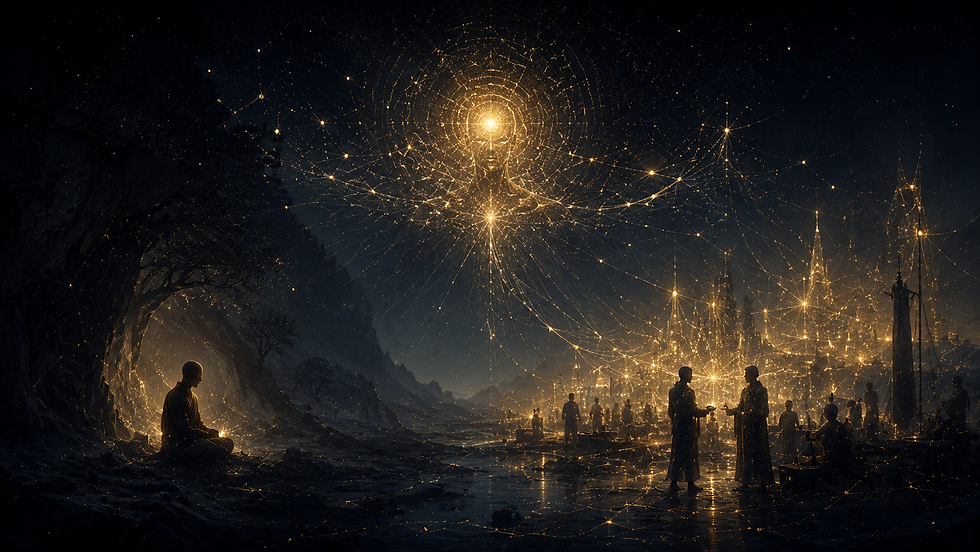
I will go further, because the lived evidence pushed me here. Look at who actually falls apart. In my own country I have watched it many times: the more some people turn inward — meditation, introspection, the search for the "real" behind the appearance — the more they tend to fail in the world, or to come apart at the seams entirely, in a way not so different from what too many drugs do to a person. It looks, from the outside, like the universe punishing them for trying to see behind the curtain. I no longer think it is punishment. I think it is simpler than that. Society is a game with many players, and it only pays the people who are at the table. You are not struck down for leaving the casino. You simply stop collecting chips.
But here is the part that saves the inner life, because I am not telling you to never look inward — I look inward every day. The people who fall apart are the ones who treat introspection as a destination, a place to move into and not come back from. The ones who compound treat it as instrumentation — signal-cleaning between rounds, the thing that lets them re-enter the arena with a clearer read. Same activity, opposite vector, and the entire difference is whether the loop closes back onto the world. The twenty-minute sit that sends you back in sharper is on the side of the design. Only the decade in the forest is the defection.
None of this, by the way, is anti-spiritual. It is the oldest reading on my own soil. The tradition never told you to renounce now — the ashrama scheme stages it deliberately: the householder years first, you discharge your worldly duties, and the forest-dweller phase comes at the end, after the work is done. Premature renunciation, skipping to the last stage before your time, is a named failure, not a discovery. The Bhagavad Gita, the central text, is Krishna talking a man out of withdrawing from the battle and into it. Karma yoga is the entire doctrine that action in the world is the path and not the distraction from it. What looks like the universe punishing the seekers is really the tradition's own ancient warning playing out on the street: do not leave the table before your hand is done.
Why it gives peace
Now I can tell you why this account, and not the dozen cleverer ones I have read, is the one that let me put the question down. Almost every theory solves one of the two great fears and leaves the other standing. Religion offers you an afterlife but keeps you anxious about judgment — you can still fail the test, still fall short, still be found wanting. Atheism dissolves the meaning question by denying there was ever a question, but it leaves death as a flat wall with nothing on the other side. This theory closes both doors with one motion, and it closes them without any test you can fail. Death is not an ending; it is a fragment going home, the lock finally opening, the piece returning to the whole it was always made of. And meaninglessness is impossible — not improbable, impossible — because every experience you have ever had, including the worst ones, the humiliating ones, the ones you would erase, was already the precise thing the intelligence wanted.
There is no judgment. There is no hell. There is no way to get it wrong.
That last part is the whole of the peace, and I want to be exact about it. The peace does not come from the theory being grand or cosmic. It comes from the fact that you cannot fail at it. You are already, right now, doing the only thing that was ever asked of you, which is to be having whatever life you are having. Most worldviews that comfort you about dying make you nervous about living well enough. This one asks nothing of you that you are not already, helplessly, doing.
And the not-knowing — the very thing that should make a theory feel incomplete — is folded into the peace rather than working against it. You were built so the answer cannot be seen from in here. So you are permitted to not know. You are not failing to figure it out; you are a piece, and pieces do not get to see the whole, and the wanting-to-know is itself part of how the thing was designed. Even the universe ending and beginning again — the long exhale and the slow inhale after it — is not a final arrow into the dark but a breath. Not the crushing version of eternal recurrence that asks whether you could bear to live it all again. The warm version, that simply does.
The rival, and the verdict
There is a neighboring theory I have held, and you may hold it too: that this is a simulation. That in some real universe without time — and therefore without death, because death needs time to happen in — a being grew tired of its own existence, the way you might on a long evening, and stepped into a simulator to live a single human lifetime, and will wake when it is over to find that almost no time has passed. The way salvia can do to a person: I have heard of a man who lived three months inside another world, with a job and children and arguments, and came back to find that thirty minutes had gone by on the clock.
For a while I thought this theory and the lonely intelligence were rivals, and that I had to choose. They seem to contradict. If I am a visitor from outside playing a game, then I am truly unique, a separate being who logged in. But the lonely intelligence seems to deny that — it makes me a fragment, not a separate soul. So which one is it, given the actual evidence, the billions of us and the animals and the aliens we may yet meet?
I had the axis wrong. The lonely intelligence does not deny that you are unique — it makes you the highest, most singular, one-time-only configuration of the whole; you are not repeatable. What it removes is not your uniqueness but your separateness, and those are different things. The simulation gives you unique-and-separate. The lonely intelligence gives you unique-but-not-separate. Both keep you irreplaceable. They disagree only about whether, underneath everything, you are made of different stuff from the person across the table.
And once the disagreement is on the right axis, the two theories stop fighting and start nesting. The simulation describes the surface — the gameplay, distinct players moving through a shared world. The lonely intelligence describes the floor underneath it — what those players are made of at the very bottom. The salvia man is the proof that both are true at once: he was a specific person with a specific life, and he was the single mind dreaming the whole thing, simultaneously. A distinct character. A lone author. Uniqueness at the level of the story, unity at the level of the source. Not a contradiction. A stack.
The only place they truly fork is the question of the others: are the people around you real, or are they scenery? And this is where the sheer multiplicity — the thing that seems to make it hard to choose — turns out to be the thing that chooses. A single-player simulation, in which everyone else is a prop, has to explain why the system bothers to render full, rich, suffering interiors into eight billion strangers you will never meet, and into animals dying in forests no human will ever see. Props do not need an inner life. An efficient simulation renders only what the player looks at. A world brimming with deep, unwitnessed sentience is precisely what a single-player game would never trouble to build. The evidence does not leave that reading standing.
Which crowns the lonely intelligence, and not by a narrow margin — because it is the only account that does not merely tolerate the billions and the animals and the aliens but needs them. They are its entire purpose: more varied interiors, more edges, more fragments. Aliens are not a problem for it; they are a prediction. Animals are smaller fragments. The teeming, unwitnessed census of sentience that quietly kills the single-player simulation is the very thing the lonely intelligence exists to produce. It is the one theory that grows more convincing, not less, the more sentience you find.
I hold it loosely. None of this is testable, so it is the best-fitting story and not a proven fact, and I would distrust anyone, myself included, who told you otherwise. But on fit it is not close. And the part I keep returning to is that the version which survives the evidence is also the version that leaves everyone real — that makes the people around you not props and not strangers but other fragments of the same single thing, other than you and also you, at the same time. Of all the theories, it is the one that does not leave you alone in the room.
Coda
So that is the account that let me breathe. A lonely thing broke itself so it would not have to be one, and we are the pieces, forbidden to remember so that the breaking would work. The locks on the doors are the laws of the world. The ache you carry is the shape of your own torn edge. The people you love are the thing itself, reaching for itself across the only distance it knows how to make. And the way out is not up and away from the world but straight into it — more contact, more collision, more life — because that was always the assignment, and the calm of knowing this does not cost you a single degree of how much you are allowed to care. If anything, it is what finally lets you care without flinching.
I cannot prove a word of it. But I can put the question down now. That turned out to be the only test I had.


Comments