Part IV · When the Villain Goes Bad
Chapter 9
One More Round
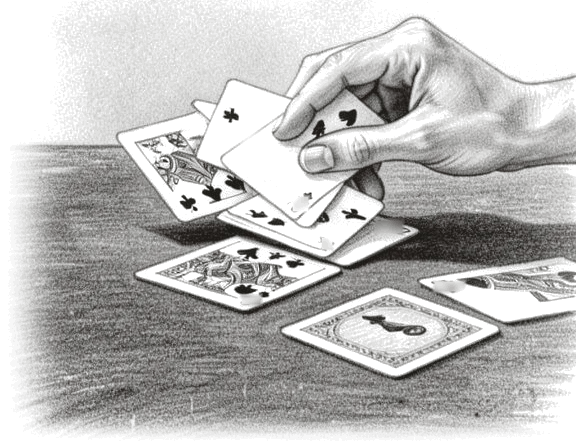
"The house always wins." It is a strange sentence to say just before deciding to play against it.
You have identified the opponent, acknowledged its advantage and then bought a seat in the fight. Maybe tonight you will be the exception.
A casino gives the mind something unusually convenient.
There is an institution on the other side, a defined game and repeated outcomes. The next attempt is available almost immediately.
The opponent does not die when you defeat it locally.
It remains there, able to take the money back.
A trader's activity is different. Markets include investments in productive businesses and people operating on very different time horizons.
But listen to the language around a screen on which the price has just moved the wrong way.
"Of course. The minute I bought."
It can sound like somebody was waiting.
"I beat the market" gives that adversary a name.

The algorithm can have no mind and still give a creator a renewable fight.
Post something. Wait. Nothing. Change the opening, change the timing.
Your move · What does he do tomorrow?
Suddenly something travels much further than expected. "Finally. It likes this." The creator knows what he just said is not literally true.
Tomorrow he posts again anyway.
These are different systems. Their psychological compression has a shared advantage: it gives an uncertain world enough shape to keep engaging with it.
And they can regenerate opposition at a frequency a mountain cannot.
You do not need to arrange another expedition. Open the screen. The next result is waiting.
This can be compelling even when little useful learning accumulates. Uncertainty keeps supplying tension, and a lucky outcome can feel like earned progress.
That is where we need to remember the distinction between feeling powerful and having retained the ability to produce another win.
The screen is very good at producing the first feeling occasionally.
The second is a harder matter.

But remember the bottle from Chapter 2.
The person trying to stop. A bottle does not disappear when you win one round against it. It comes back the next day.
It regenerates opposition at exactly the frequency the person cannot manage.
It has the same shape as the casino and the screen.
It is always available, and it is always close. But the person trying to stop has a very different relationship with winning.
The villain has found a way of being defeated without going away.
For a person trying to stop, that can be precisely the problem.
Weak Villains
The internet can supply a rival before breakfast.
More followers. A better holiday. Someone younger doing something you have been meaning to do for years.
What is odd is how much opposition can arrive without becoming a sustained fight.
You are irritated. You reply, or think about replying.
Ten minutes later you are looking at something else, with a little of the irritation still floating around and no very clear idea of what it was supposed to make you do.
We have already distinguished difficulty from againstness. Now I think we need another distinction.
Something can feel against you without becoming a strong antagonist.
It has captured attention. It has not necessarily organised action.
Think about the difference between an anonymous insult and being challenged directly by somebody whose opinion matters to you.
There is a face. A voice. People nearby who heard what was said.
The comment from the wedding in Chapter 2 was doing some of this work.
One person said something careless in a setting that mattered, and suddenly there was somebody to answer.
Perhaps these mild digital provocations are too plentiful to gather much history.
Perhaps the audience is too vague. Perhaps we cannot work out what a win would look like.
Someone has a million followers. I have fewer.
Are we playing the same game? Who decided?
The number makes comparison wonderfully easy while leaving those questions unanswered.
A real rival can reveal something worth improving.
You know what they did better, and another attempt lets you test whether you have changed.
A weak rival may supply only the feeling of being behind. You can refresh that feeling indefinitely. No rematch needed.
The internet has made both kinds easier to find. Somebody can discover excellent work and begin learning seriously because of it. Somebody else can spend the afternoon monitoring a stranger's success with increasing irritation.
Same screen. Very different relationship with resistance.
This is why "more competition" is too vague to explain engagement.
We can surround a person with comparisons and still fail to give them a fight they can actually have.
The world's largest antagonist generator may be producing enormous quantities of very weak antagonists.
They keep saying somebody else is ahead. They rarely make it clear where we thought we were going.
A weak villain costs you an afternoon.
A wrong one costs someone else far more.
When We Choose the
Wrong Villain
The rush of beating something has a very inconvenient indifference to whether the outcome was fair.
It cannot tell us whether the win was any good.
That leaves an unpleasant possibility in everything we have discussed so far.
A villain can be psychologically useful and factually wrong.
The story can work inside the person even when it fails outside them.
Rwanda, 1994, is the far end of this.
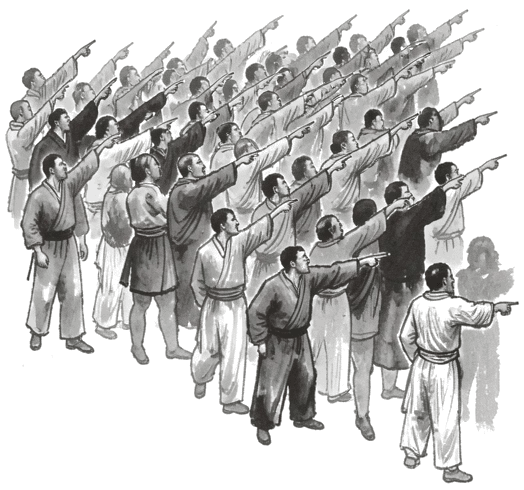
In the months before the genocide, a newspaper called Kangura called Tutsi people inyenzi. Cockroaches. A radio station, RTLM, read out the names and locations of people to be killed.
Those people were neighbours.
Nobody begins there. It usually begins much smaller, with a vague complaint that names a group.
"They're taking everything."
"They always help their own."
"You can't trust them."
The sentences are almost empty of specific information. Yet they can fill a room with certainty.
The group supplies a face for frustrations that may have arrived through entirely different routes.
Money, status, work, an old humiliation, fear of change. Now those frustrations have somewhere to go.
And belonging can become easier too. We may disagree about almost everything else.
But we know who we are against.
This is how entire societies can organise themselves around a common enemy.
Enemyship research examined how threats to perceived control could affect the influence people assigned to enemies. We encountered that idea near the beginning of the book.
Here the uncomfortable part is the word influence.
The enemy can become powerful enough to explain the disorder. Something is going wrong because somebody is doing it.
That may feel easier to inhabit than admitting how much remains uncertain.
René Girard, Sam Keen and Vamik Volkan each looked closely at the moment a human being becomes a role. The Afterword says more about them.
The villain.
Once that role is secure, ordinary behaviour becomes surprisingly easy to reinterpret.
They helped someone?
They are trying to look good.
They object to the accusation?
Of course they deny it.
They say nothing?
That tells you everything.
The person has lost the ability to produce evidence that changes the story.
We have built an opponent who cannot escape being an opponent. And that can feel like conviction, even courage, from inside the group telling the story.
Lose the enemy and we may lose the thing that made our anger coherent.
We may also lose the agreement that made us a group.
This is not an argument for refusing to name real wrongdoing. A person can commit an abuse. An institution can discriminate. Responsibility can be established and challenged.
But notice how different "this person did this" is from "these people are what is wrong with the world."
The second sentence supplies a much larger villain. It also supplies permission to stop seeing individuals.
That is the ethical danger of a mechanism that can make opposition feel so useful.
The same feeling that helps somebody persist with a difficult problem can be attached to people who have become convenient targets.
The fight then keeps giving the fighter something while taking something terrible from the target.
Check · From memory
This chapter says a villain can be two things at once. What are they? Say them in your head, then look.
- 1Psychologically useful
- 2factually wrong.
Close
A human enemy can organise us extremely well.
We should be frightened by how little that fact tells us about whether we are right.
Notes and references
When We Choose the Wrong Villain
[1] United States Holocaust Memorial Museum, "Rwanda media trial opens." See also International Criminal Tribunal for Rwanda, "Three media leaders convicted of genocide."
[2] Sullivan, D., Landau, M. J., & Rothschild, Z. K. (2010). "An Existential Function of Enemyship."
From Villains, Power & Success: What Are You Fighting? by Uday Wagh. Abridged for the screen.