Part III · What Do You Actually Win?
Chapter 8
If You Can't Beat Them, Become Them
VIP culture is an excellent thing to complain about while standing in the ordinary queue. Someone arrives late, somebody recognises them, a barrier moves, and suddenly their time seems to be worth more than everybody else's.
"Who do they think they are?"
A family is waiting in that same queue. Now give them a different piece of news.
Their son or daughter has entered the IAS.
The pride can be entirely deserved.
Your move
But stay with one possible change. Somebody who used to complain about access may now be delighted that access has improved. The barrier moves. This time it moves for us.
Has the opinion changed, or have we discovered what the opinion was really about?
I don't think the answer is always obvious.
People can want an unfair system changed and still be proud of an achievement within it. What interests me is the case where the unfairness becomes much less troubling once the advantage becomes personal.
Perhaps the villain was never the hierarchy. Perhaps it was our position in the hierarchy.
An exclusive university offers a cleaner version.
Before admission, the place is overrated, obsessed with its own prestige, and absurdly difficult to enter. Then the admission arrives.
The university has not necessarily changed anything. Its refusal was the antagonist.
Its acceptance is now evidence that you beat the refusal.
And its continued refusal of other people may even help preserve the meaning of your win.
That is the part I find uncomfortable.
The wall you once resented can become part of the thing you are proud to have crossed.
This may happen quite gently.
An employee complains that senior management keeps information to itself. A few years later, sitting in a senior meeting, he hears a proposal to share more of it.
"I'm not sure everyone needs to know that."
The villain has been defeated through membership.
No revolution required. The institution can absorb its critics by giving some of them the place they wanted.
This does not mean everyone abandons their principles on entry. Some people use the position to change exactly what they disliked.
But entry tests the story in a way exclusion cannot.
"I want a fairer world" and "I want a better seat" can live inside the same sentence for years.
Then the seat changes.
Sometimes we discover we wanted to flatten the fortress.
Sometimes we wanted to get inside.
And some people never want in. They build a whole self out of staying outside.
I Am Not Them
"The system" is a remarkable opponent.
It can include your school, your parents, your boss, banks, examination boards, and the general suspicion that adulthood is going to be disappointing. Quite an impressive organisation. Especially considering how rarely its departments seem to coordinate anything successfully.
We have already seen the mind compress complicated resistance. What interests me now is the identity that grows on our side of the compression.
Who am I? That can be a difficult question when you are young.
Who am I not?
Much easier.
Not the teacher who wants everybody to sit quietly.
Not the uncle who thinks a good life consists of a respectable job followed by sensible purchases.
Not the people who keep saying, "You'll understand when you're older."
Being older appears to involve becoming them. So I would rather not understand.
There is real energy in that refusal.
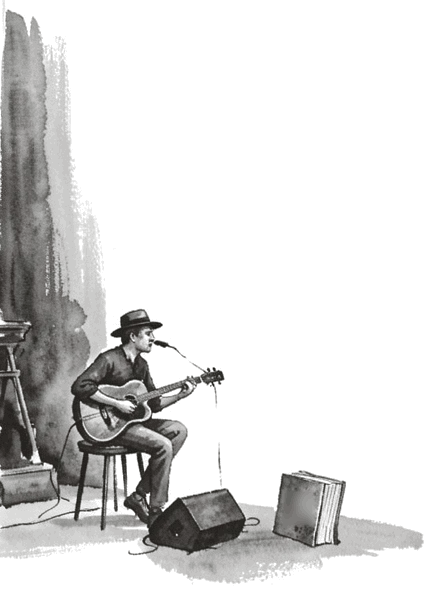
Punk makes it audible. Distorted guitars, clothes that disturb the expected appearance. The refusal does not need to arrive with a complete alternative constitution.
It gives the person a place to stand first.
"I am not them" becomes the beginning of "this is me."
Opposition is doing social work as well as motivational work.
You can hear a newer version in the language of escaping the nine-to-five.
The office becomes captivity. The commute becomes evidence. The image works because the old life has been given a role. It is what we are getting away from.
But there is an odd dependency here.
If I define freedom mainly by what office workers do not have, I still need the office worker nearby in my imagination.
"At least I'm not sitting in a cubicle."
This can be said at midnight while answering a customer email.
Startup culture can produce a similar reversal.
First come the builders against the bureaucracy. Then the organisation grows, departments appear, and somebody starts complaining about the builders' own bureaucracy.
There is another kind of person who builds an identity against the official system.
The man who knows how things really work. Ask him whether the official procedure works and he may laugh before answering. Not because nothing works. Because he knows a second procedure running underneath the first.
In India, jugaad covers this territory.
A repair made from something that was never supposed to become a replacement part. A person who knows which counter you actually need, rather than the counter the sign sends you to.
The managing can become part of how the person sees himself.
He is the person who knows how things really work.
There are plausible historical contributions to this relationship with rules.
Colonial administration, the Licence Raj. But I doubt a person needs a detailed acquaintance with colonial administration to feel pleased about finding a seam in a system.
The more immediate mechanism may be simpler. A rule appeared to settle what would happen. Then I changed what happened.
What I keep noticing is that rebellion supplies clarity before it supplies a detailed destination.
The system says this is how life is done. We say no. Now there are two sides.
The difficulty comes later.
If the system vanished, would I know who I was? Or would I need to find something else to stand against before I could begin answering?
Check · From memory
About a fortress we resented: what might we discover we had wanted? There are two answers. Say them in your head, then look.
- 1Sometimes we discover we wanted to flatten the fortress.
- 2Sometimes we wanted to get inside.
Close
Some opponents solve that problem.
They never vanish.
From Villains, Power & Success: What Are You Fighting? by Uday Wagh. Abridged for the screen.