Part VII · Which Villain?
Chapter 14
The Enemy That Never Quite Dies
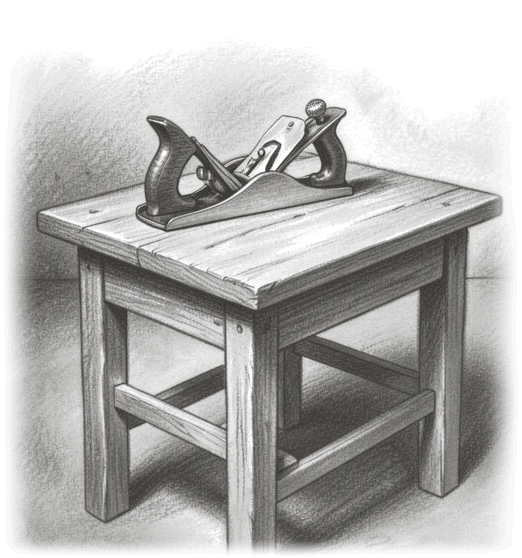
A finished table is a useful thing.
It is especially useful if the carpenter eventually lets it leave the workshop. There can always be something else to improve. But at some point somebody wants to eat dinner on it.
Your move · Does the carpenter stop too?
So the piece ends.
The craft does not.
That distinction may offer an answer to the problem we have kept finding after victory.
A local win can be complete without leaving the person with nothing further to confront.
The carpenter has made this table. He has not exhausted making tables.
The next piece can be difficult in a way the last one was not.
A different wood behaves differently. A joint he could previously overlook now bothers him because he can see how much better it could be.
Getting better has made him more aware of the resistance.
He does not need to pretend the previous achievement failed in order to find a new question.
James Carse's distinction between finite and infinite games helps me think about this.
A finite game aims toward a win.
An infinite game aims toward continuing play.
That does not mean we should leave the table unfinished and tell the customer we have transcended endings.
The piece needs an ending. The larger relationship with the work can remain open.
Writing has something of this arrangement.
A book can be finished.
The writer can still notice something she has not learned how to say.
Science can answer a question and find the next one inside the answer.
Medicine can solve a particular problem while the broader work keeps meeting new problems and better possibilities.
These opponents can lose locally without vanishing permanently.
There is a difference from the house in Chapter 9, which offers one more round whenever the player wants one.
Renewal alone was never enough.
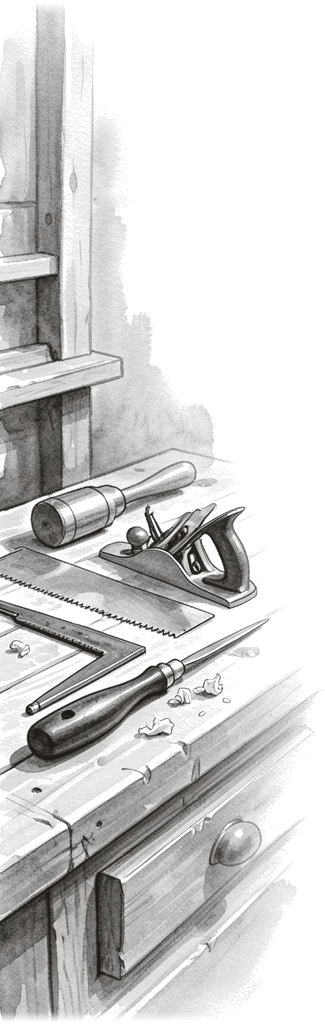
The more interesting renewal lets capability accumulate and lets the next resistance ask a changed question.
The carpenter can now attempt something the earlier carpenter could not. The work continues partly because the person has grown, rather than because yesterday's irritation can be generated again.
This makes mastery a peculiar sort of enemy.
As you get better, you begin to see difficulties you could not even notice before.
There is no need to invent a hostile intention. The material does not dislike you. The sentence is not plotting. Yet something in the work refuses the easy version strongly enough to make another attempt worth having.
Over time, enemy may cease to be the best word.
The carpenter loves the craft that frustrates him. The scientist is grateful for the question that will not settle.
The relationship has kept the useful resistance while shedding much of the need to be at war.
That is a better ending than discovering we must keep somebody unpleasant nearby forever.
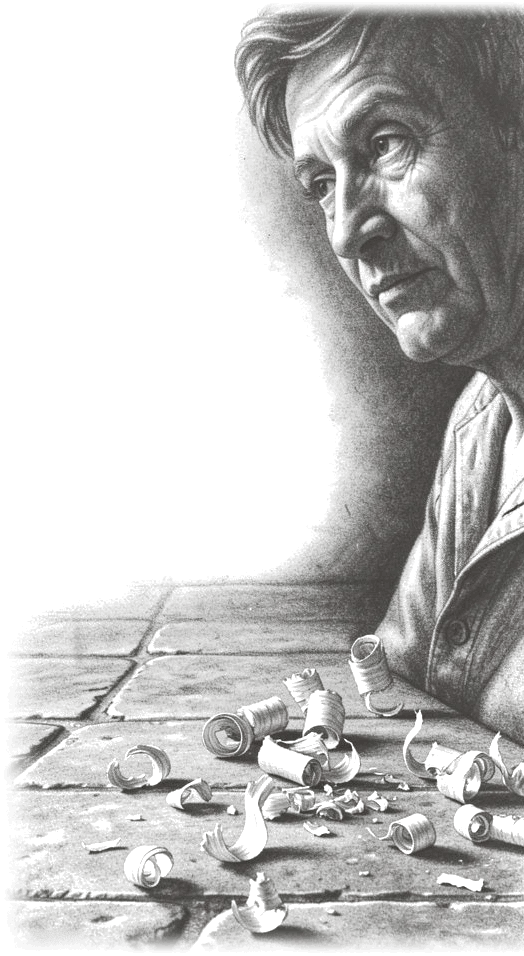
There can be rest. There can be other interests. There can even be a point at which the person leaves the craft.
Continuing play is not an order never to stop.
What it gives us is a way of letting one result be sufficient without asking it to settle the entire future.
The table leaves. The carpenter knows what worked. He also knows something he would like to try differently.
Yesterday's win has not become worthless.
Tomorrow has not become empty.

What Are You Fighting?
Think again about the superhero who had nothing to do. The city was safe. Breakfast, email, a meeting, another ordinary day. Everything going well, and very little reason to keep watching.
That was easy to notice in a film. What bothered me was the possibility that something similar could happen inside a life that looked successful from outside.
We ask what people want.
We teach them to make the answer clearer, more measurable and more ambitious. Sometimes it helps enormously. Sometimes the clear answer still does not explain what makes the person move.
That was why I wanted to ask what they were fighting.
The answer could be much less respectable than the goal. A sentence from school. A person whose name still changes the mood. An institution that refused entry. The feeling that somebody, somewhere, thinks you cannot do it.
It could also be a problem worth spending a life on.
The question does not know in advance. I think that is part of its usefulness. It asks about the thing actually organising the effort, rather than the destination we have learned to name politely.
And the answer can change how success looks.
If I am trying to obtain security, enough security ought to count for something. If I am trying to answer a humiliation, the same amount may fail to settle the argument.
The bank balance can be identical. The unfinished story can be completely different.
There are people for whom this way of thinking will be only mildly useful.
Competition tires them. Curiosity, care or beauty gives them enough reason to begin. Good. We do not need to put a villain behind every meaningful act to preserve an interesting hypothesis.
Music can simply be beautiful. A person can love someone without needing an enemy to make the love important.
So here is the claim I am willing to keep.
For many of us, much of the time, what we call purpose is what a fight feels like from the inside.
Not for everyone, and not for everything. But often enough that it is worth asking.
Perhaps the word villain has helped us notice a relationship that eventually becomes more generous than the word sounds.
The scientist does not have to hate the question.
The two players can want each other to lose and still be friends. The writer can finish one book and remain interested in writing.
We have found some relevant research, some useful distinctions and a pattern that seems worth testing.
We have not found a law of nature.
What remains clear to me is that opposition can make a person astonishingly alive. It can also make them astonishingly unfair.
That is why the book cannot end with the motivational question alone.
A fight can work. The fact that it works inside me does not establish that it deserves the time, or that the people on the other side deserve the role.
Sometimes an old opponent should be allowed to become unimportant. Sometimes a finished pursuit should be enjoyed rather than immediately enlarged. Sometimes the resistance ahead really is worth another attempt.
We do not have to answer in the same way forever. The protagonist is allowed to change the story.
So I come back to the question we started with.
What are you fighting?
And now I would want to stay long enough to ask the other one.
Is it worth fighting?
Where These Ideas Meet Other Ideas
Once I began following this question, related ideas started appearing in places I had not initially been looking. That is a pleasant experience. It is also easy to narrate badly afterward.
We can draw a very tidy line from famous thinker to famous thinker and make the finished idea look as though it had a distinguished family waiting for it all along.
I would rather describe neighbours.
Some of the connections were found after the questions had already begun taking shape. They helped clarify a part of the argument, complicated it, or supplied language for something I had noticed less precisely.
Nietzsche is an obvious neighbour around power. His connection between overcoming resistance and the feeling of increasing power makes victory look larger than the reward acquired. Something yields, and the person experiences an expansion. The ethical question of what deserves to yield remains ours to ask.
Schopenhauer comes into view around desire and satisfaction. He is much more pessimistic about their movement than I am. Still, his attention to the way satisfaction can give way to boredom makes the morning after arrival harder to ignore.
Kent Berridge and Terry Robinson give the discussion a more precise distinction: wanting and liking. Their work helped separate the pull toward a reward from the pleasure of experiencing it.
That let the hunter's behaviour make sense before dinner, without asking the pleasure of dinner to travel backward through time.
Dan McAdams supplies another connection through narrative identity. People organise a remembered past and imagined future into evolving stories about who they are. The opponent can become part of that organisation.
Nicholas Epley, Adam Waytz and their colleagues make the mind's contribution more visible. Their research on anthropomorphism helps explain why we give a machine preferences, a market moods, or an algorithm something it supposedly wants.
Enemyship research by Daniel Sullivan, Mark Landau and Zachary Rothschild meets that thought from a different direction. Under some conditions, assigning influence to an enemy can help compensate for threats to perceived control.
That question leads toward René Girard, Sam Keen and Vamik Volkan. Girard's work on scapegoating examines how a victim can come to carry collective hostility.
Keen's hostile imagination asks us to inspect the pictures through which the enemy becomes monstrous. Volkan's psychoanalytic account of enemies, allies and large-group identity follows another route toward the emotional life of groups.
Ernest Becker introduces mortality and the wish for significance. His account of heroism makes a pursuit of lasting importance look different from a pursuit of a larger purchase.
David P. Barash appears in two places. His Threats: Intimidation and Its Discontents examines threat dynamics.
His Beloved Enemies: Our Need for Opponents has the closest title and premise to this book. If you read one neighbour, read that one. His book asks about our need for opponents.
This one follows the question through stories, hunting, wanting, power and the morning after a win, and then asks which opponents deserve the job.
Sebastian Junger's work on belonging offers a valuable correction to a book that spends so much time looking at opposition.
A demanding shared situation can make people feel needed by one another.
What someone misses afterward may be mutual responsibility and companionship, not an enemy.
Then Bernard Suits and James Carse help think about chosen resistance.
Suits makes the unnecessary obstacles of games intelligible. Carse distinguishes an orientation toward winning from an orientation toward continuing play.
A good neighbour makes the idea less comfortable in a useful way.
The framework should be able to meet those questions without absorbing every answer into itself.
Otherwise it would become another opponent that refuses to move regardless of the evidence.
Check · From memory
The chapter ends on two questions: the one the book started with, and the one it adds. Say them in your head, then look.
- 1What are you fighting?
- 2Is it worth fighting?
Close
I would like it to remain a question we can use, test and sometimes leave aside.
Something that makes a familiar life look a little stranger, long enough for us to notice what has been receiving our effort.
Notes and references
The Enemy That Never Quite Dies
[1] Carse, James P. Finite and Infinite Games (1986).
Where These Ideas Meet Other Ideas
[1] Nietzsche, Friedrich. The Antichrist, section 2.
[2] Schopenhauer, Arthur. The Wisdom of Life.
[3] Berridge, K. C., & Robinson, T. E. (1998). "What is the role of dopamine in reward." Brain Research Reviews, 28(3), 309–369.
[4] McAdams, D. P., & McLean, K. C. (2013). "Narrative Identity," Current Directions in Psychological Science, 22(3), 233–238.
[5] Epley, N., Waytz, A., & Cacioppo, J. T. (2007). "On Seeing Human." Psychological Review, 114(4), 864–886.
[6] Sullivan, D., Landau, M. J., & Rothschild, Z. K. (2010). "An Existential Function of Enemyship."
[7] Girard, René. The Scapegoat.
[8] Keen, Sam. Faces of the Enemy.
[9] Volkan, Vamik D. (1985). "The Need to Have Enemies and Allies." Political Psychology, 6(2), 219–247.
[10] Becker, Ernest. The Denial of Death (1973).
[11] Barash, David P. Threats: Intimidation and Its Discontents (Oxford University Press, 2020). And Beloved Enemies: Our Need for Opponents (1994).
[12] Junger, Sebastian. Tribe: On Homecoming and Belonging (2016).
[13] Suits, Bernard. The Grasshopper: Games, Life and Utopia (1978).
[14] Carse, James P. Finite and Infinite Games (1986).
From Villains, Power & Success: What Are You Fighting? by Uday Wagh. Abridged for the screen.