Part V · What Happens If You Win?
Chapter 11
Bigger Prey
₹1 crore can look enormous from a long way away.
Then you reach it. Now you know people for whom it is not enormous at all.
This is one of the quieter effects of moving upward.
You acquire money and a new set of people capable of making the money look small. ₹10 crore begins to feel more convincing. Then ₹100 crore.
The numbers may have perfectly practical explanations. But sometimes the explanation sounds suspiciously similar at every scale.
“Then I'll be comfortable.”
Comfort keeps having to move house.
We have been looking at rewards that lose their old motivational role once obtained. A larger reward restores that role rather efficiently.
It is ahead again. It can refuse you again. Progress has somewhere to go.
There is also a genuine capability problem here.
A beginner can find an ordinary hill demanding. Someone who has become much stronger may need a harder climb to feel the same uncertainty.
As power grows, the familiar opponent becomes less capable of pushing back.
That is success doing something inconvenient to its own source of engagement.
The person becomes better at winning. The old contest becomes easier to win. Now winning it tells him less about what he can do.
So the prey grows.

One business becomes several. A house becomes an estate, then perhaps an island. The next outcome is large enough to make failure believable again.
Sometimes that is real development.
Your move · Can size alone tell the two apart?
The person has learned something and wants to attempt what the learning makes possible.
Sometimes it is mainly the old feeling returning in a larger costume.
I don't think we can distinguish them by the size of the ambition alone.
What I notice is how escalation can solve the immediate psychological problem without solving the question underneath it.
The person does not have to work out why arrival became quiet. They can make something else distant.
A little conversation might reveal it more plainly than the financial plan.
“You said the first amount would be enough.”
“Things change.”
“What changed?”
“I can do more now.”
That could be exactly true.
It could also mean that the old target can no longer provide enough resistance to make the doing feel the same.
The important word is enough.
Enough for what?
Enough to live safely?
Enough to be admired by the new circle?
Enough to feel that there is still something difficult on the other side?
Those are different calculations hiding inside the same number.
Bigger prey can renew the chase.
The chase does not necessarily become a different kind of life merely because another zero has been added.
Billionaires Still Need Villains
There is a point at which a better refrigerator probably cannot do much more for your life.
Food is already cold.
This is what makes extreme wealth interesting for the question we have been following.
If ordinary material life is already comfortably supplied, what is the next enormous effort for?
Another billion can still change rank. Another company can defeat a rival. The largest project can demonstrate a kind of power ordinary purchases no longer test.
Perhaps the hunt has moved away from things that can simply be bought. Toward outcomes that can still refuse the buyer.
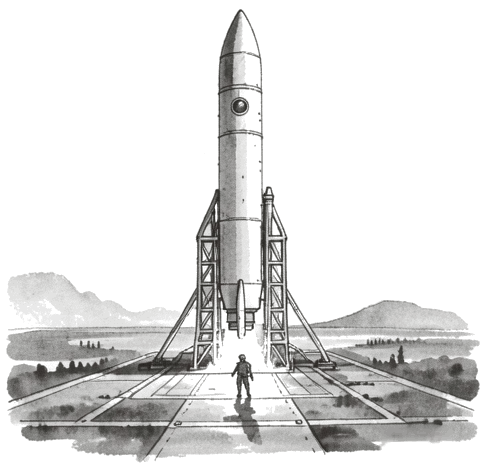
A rocket is useful to think about here. Money can obtain equipment, people and time. It cannot persuade physics to overlook a problem in the design.
You can pay for another attempt. The attempt still has to work.
Jeff Bezos founded Blue Origin, and its stated vision is that millions of people will live and work in space.
Whatever his private motivation, that goal has plenty of distance left inside it.
The destination is large enough to hold a pursuit.
Longevity. Legacy. A company larger than another person's company. A future difficult enough that immense resources are a starting point rather than a completed answer. At that scale, money may continue keeping score while the real contest shifts elsewhere.

Then there is a more interesting shift. From defeating another rich person to defeating a problem.
Malaria does not care where the donor appears on a wealth list. Education does not become good because someone has bought an impressive building.
The Gates Foundation's malaria programme offers a concrete example of organised work toward a large disease objective.
The contrast helps sharpen the idea.
In one contest, the result matters partly because somebody else has less prestige afterward. In another, the result could matter even if nobody knew who paid for it.
The opponent has become something we would be glad to see lose.
There is genuine resistance too.
Research can fail. Delivery can fail. A technically promising answer can turn out not to work for the people expected to use it. That may be part of what makes it a better opponent. It forces attention beyond the protagonist.
This does not make every grand mission wise.
The work has to be judged by what it changes, not the size of the cheque. But a constructive possibility appears. The power accumulated through earlier fights can be used against resistance whose defeat would be useful to other people.
Perhaps billionaires do not stop seeking opponents when they run out of ordinary necessities. Perhaps some seek opponents large enough to resist what they have become.
And what about the children who grow up inside that win?

Born After the Victory
"You don't know how hard I worked for this."
The child may know the story extremely well. The first salary. The small room. The years when every expense had to be considered.
He knows what happened. He does not know what it felt like to live before the ending was known.
That is a difficult thing to inherit. The house transfers quite easily. The uncertainty does not.
Money, safety, connections and status can pass from one generation to another. The fight through which the previous generation acquired them cannot be handed over in quite the same way.
The child begins inside an outcome. Somebody else's finish line has become his starting point.
This can be a wonderful advantage.
We should not become sentimental about hardship merely because hardship sometimes supplies a clear reason to act. The parent did not struggle to give the child an equally difficult struggle.
But watch the two wishes begin to collide.
"I did this so you wouldn't have to worry."
"Why aren't you as hungry as I was?"
The hunger was one of the things success removed. Now its absence is being treated as the child's defect.

I think the more interesting question is what happens when possession precedes personal pursuit.
The reward is available before it has had a chance to become prey.
The person can enjoy the fortress without ever having faced its closed gate.
A family name can help a call get answered. It cannot entirely supply the experience of knowing what to do once somebody answers.
Otherwise borrowed power can be available in enormous quantities while the person's own relationship with resistance remains strangely untested.
The result might be aimlessness.
It might also be a determined search for a field in which the inherited advantage is less decisive.
A craft. A sport. Research. Work in which somebody else's accomplishment cannot perform the next move.
The child need not recreate poverty to discover agency. But the next meaningful story probably needs something that has not already been settled on his behalf.
This is larger than wealthy families. A generation can inherit safety, education and freedoms secured through earlier struggles.
Those gains matter precisely because the next generation does not have to begin again from nothing.
Still, preserving a victory and feeling the pursuit that produced it are different experiences.
Check · From memory
The chapter asks "Enough for what?" and gives three answers. Say them in your head, then look.
- 1Enough to live safely?
- 2Enough to be admired by the new circle?
- 3Enough to feel that there is still something difficult on the other side?
Close
At some point the child may have to answer a question the parent's achievement cannot answer for him.
What is left for me to make happen?
Notes and references
Billionaires Still Need Villains
[1] Blue Origin. Stated vision.
[2] Gates Foundation. Malaria programme.
From Villains, Power & Success: What Are You Fighting? by Uday Wagh. Abridged for the screen.